IRON CORE
TACTICAL
IRON CORE
TACTICAL
ATLAS ALLIANCE
When the Northeast collapsed, governments fell, communications failed, and entire regions disappeared into chaos. Cities became battlegrounds. Supply chains vanished. Trust became a luxury few could afford.
While others fought for territory, survival, or personal gain, a coalition of military leaders, emergency management officials, engineers, law enforcement professionals, and civilian volunteers came together with a different vision.
They called themselves Atlas.
Named after the titan who carried the world upon his shoulders, Atlas was founded on a simple belief: civilization could still be saved.
From secure enclaves and fortified communities, Atlas began restoring order where others saw only ruin. Roads were reopened. Hospitals were protected. Power grids were repaired. Refugees were sheltered. What started as a regional emergency response network soon evolved into the largest organized force remaining in the Northeast.
To its supporters, Atlas represents hope, stability, and the possibility of rebuilding a functioning society.
To its enemies, Atlas is an expanding authority determined to impose its vision of order on a fractured world.
Today, Atlas controls strategic infrastructure, transportation corridors, and critical resource centers throughout the region. Its forces are disciplined, well-equipped, and highly organized. Every operation is carefully planned. Every objective serves a larger purpose.
Yet the future remains uncertain.
Intelligence reports indicate that a growing insurgent movement known as Crimson has begun disrupting Atlas operations across the region. Supply convoys have disappeared. Communication sites have been sabotaged. Entire communities have vanished from Atlas control.
The struggle for the future of the Northeast has reached a critical point.
At the center of that struggle lies The Foundry—an abandoned industrial complex believed to contain information and resources capable of shifting the balance of power.
Atlas has mobilized its forces.
The mission is clear:
Restore order.
Secure the region. Protect the future.
The Northeast will not rebuild itself.
Atlas carries the burden of that responsibility.
And failure is not an option.
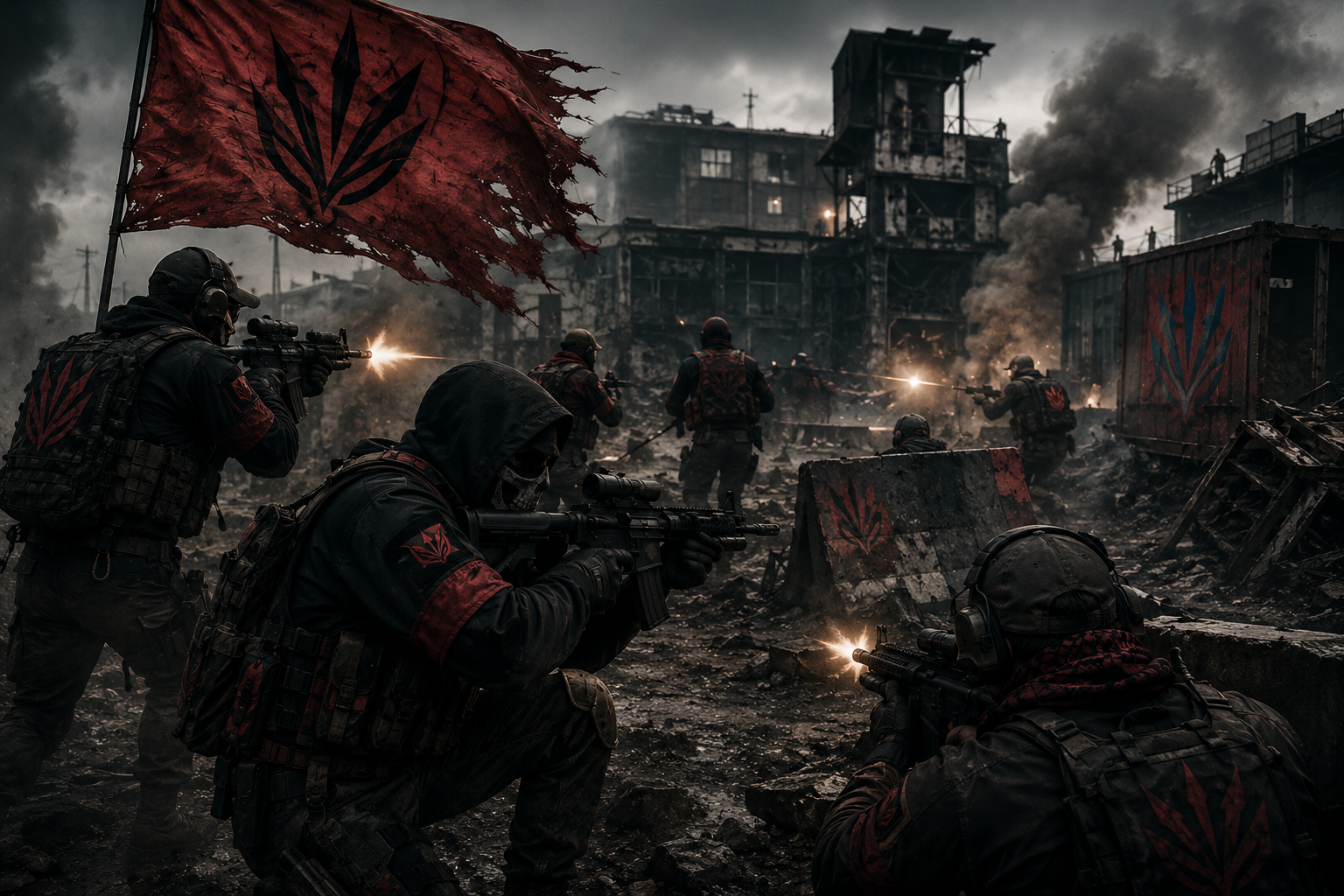
CRIMSON FACTION
When the old order collapsed, nobody came to save the Northeast.
Governments fractured. Supply chains disappeared. Communications failed. Cities were abandoned. Entire communities were left to survive on their own while distant authorities argued over maps that no longer mattered.
From the ruins emerged countless groups of survivors: former soldiers, hunters, tradesmen, mechanics, first responders, farmers, and ordinary citizens who refused to die quietly. At first, they fought only to protect their families and neighborhoods. Over time, however, they realized a harsh truth: survival belonged to those willing to seize it.
These scattered groups eventually united under a common banner.
They became Crimson.
Unlike Atlas, Crimson is not an army. It has no formal government, no centralized command structure, and no faith in institutions. Its strength comes from adaptability, initiative, and the determination of individuals who have learned to survive without permission.
Crimson fighters wear whatever equipment they can acquire. Their weapons are often mismatched. Their tactics are unconventional. Their leaders earn authority through action rather than rank. What outsiders see as disorder, Crimson calls freedom.
For years, Crimson has controlled vast territories throughout the devastated Northeast, establishing hidden supply routes, intelligence networks, and fortified settlements beyond the reach of organized forces. Every attempt to eliminate them has failed.
Now a new threat has emerged.
Deep within the industrial ruins known as The Foundry, intelligence reports indicate the existence of strategic assets capable of shifting the balance of power across the region. Atlas believes these resources must be secured and controlled in the name of stability.
Crimson sees things differently.
To Crimson, Atlas represents the return of the same centralized power structures that failed humanity in the first place.
They believe no single faction should control the future of the Northeast. If The Foundry contains weapons, technology, intelligence, or resources capable of rebuilding civilization, those assets must never fall into Atlas's hands.
As both factions converge on the region, Crimson operators move through the shadows of abandoned factories, forgotten tunnels, and shattered streets. Their objective is simple:
Deny Atlas control.
Seize what can be used.
Destroy what cannot.
And prove once again that survival belongs not to the strongest government, but to those willing to fight for their own destiny.
For Crimson, this is not a war of conquest.
It is a war against control.
And they intend to win.
Important Update Regarding Operation Iron Veil
To our Operation Iron Veil community,
We regret to inform you that, due to unforeseen logistical issues involving our event venue, we have made the difficult decision to postpone Operation Iron Veil.
After months of planning, the property owner unexpectedly decided not to proceed with leasing the facility for the event. As a result, we no longer have a suitable venue capable of delivering the immersive experience we promised.
At this time, a new location has not yet been finalized. However, please know that our team is fully committed to securing the best possible venue rather than compromising the quality, realism, and authenticity that define Operation Iron Veil.
Our goal has always been to create more than just another airsoft event. We are building an immersive military simulation that offers an unforgettable experience for both Atlas Task Force and Crimson Legion operators. We will not sacrifice that vision simply to meet a calendar date.
We sincerely appreciate your patience, support, and confidence in our project. We will share updates as soon as a new venue and event date have been confirmed.
Thank you for standing with us. We promise that Operation Iron Veil will be worth the wait.
The Iron Core Tactical Team